
1.1 High pressure chemistry
High pressure chemistry allows scientists to push reactions beyond the limits of standard conditions. These reactions are carried out specialised high-pressure reactors – sealed, precision-engineered vessels designed to safely maintain elevated pressures while providing full control over the reaction environment.
Key conditions to control are:
- Temperature
- Mixing
- Ratios of reactants
- Pressure
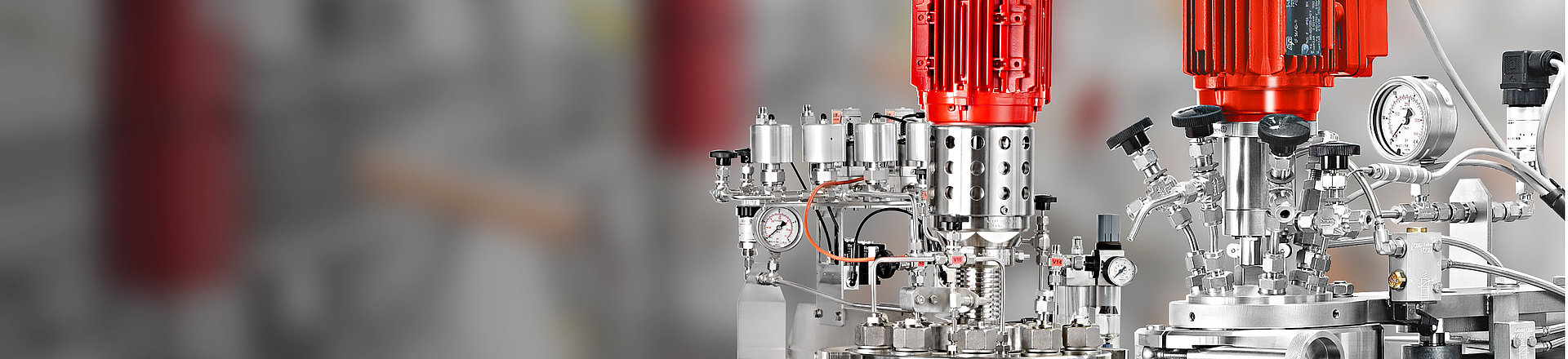
Figure showing an example of a jacketed reactor which may be used for ambient and/or high pressure chemical reactions.
By tuning parameters such as pressure (to increase gas solubility), temperature (to accelerate kinetics), stirring efficiency (to enhance mass transfer) and reactant composition, scientists can access chemistry that simply cannot occur in open-flask system. High-pressure reactors therefore play a critical role in advanced pharmaceutical, materials and catalytic research.
1.2 High pressure vs ambient pressure chemistry
- Gas solubility: High pressure dramatically increases gas dissolution (e.g. H2, CO) enabling reactions that barely proceed at ambient pressure
- Reaction rates: Elevated pressure and temperature accelerate kinetics; ambient conditions often lead to slow or incomplete conversion
- Selectivity & Yield: High-pressure environments can shift equilibria and favour cleaner, more selective pathways compared with ambient systems
- Phase behaviour: High pressure allows liquid-gas or supercritical phases that simply don’t exist at ambient pressure
1.3 Why High-Pressure Chemistry matters
High pressure systems open access to new reaction pathways, enable more efficient use of gases, and provide the controlled conditions required for modern R&D. Whether developing new catalysts, synthesising complex molecules, or studying reaction mechanisms, high‑pressure reactors give researchers the performance, safety, and reproducibility needed to innovate with confidence.
1.4 Key Applications of High-Pressure Chemistry
High‑pressure chemistry is used wherever researchers need to access reaction pathways, efficiencies, or material properties that ambient systems cannot deliver. Typical applications include:
- Pharmaceutical synthesis: Hydrogenations, carbonylations, aminations, and catalyst screening for complex API and intermediate development
- Catalysis research: Evaluation of new catalysts under realistic industrial conditions, including gas–liquid reactions and supercritical environments
- Materials & polymer science: High‑pressure polymerisation, oligomer formation, and development of advanced coatings and functional materials
- Energy & petrochemical studies: Biofuel upgrading, CO₂ conversion, reaction mechanism studies, and high‑pressure phase behaviour analysis
- Academic research: Mechanistic studies, kinetics, thermodynamics, and exploration of new reaction pathways under controlled extreme conditions
1.5 Premex – specialists in High-Pressure Reactor Technology
Premex is a Swiss engineering company with over 50 years of experience designing and manufacturing high‑pressure and high‑temperature reactors for advanced chemical research. Their systems are trusted by leading pharmaceutical companies, universities, and industrial R&D teams worldwide.
Premex are recognised for:
- Swiss precision in every component
- Proven expertise in high-pressure chemistry from ml-scale to 300L
- Custom engineering for demanding applications tailored to customers requirement
- Long-term customer relationships and loyal partnerships
- High reliability and strong service support
Premex provides the robust, high‑integrity reactor platforms needed to perform demanding high‑pressure chemistry with confidence and reproducibility.